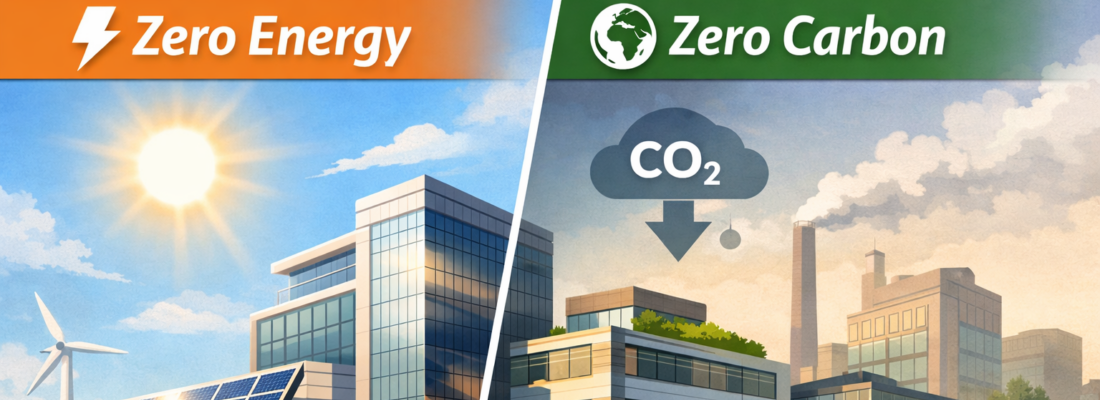
Recently, I came across a post outlining dozens of green building standards and concepts. It reminded me how quickly our industry is evolving — and how confusing it can be for decision-makers.
Behind every new building project, there is tension.
Developers want speed and cost control.
Executives want risk managed and capital deployed wisely.
Sustainability and energy teams want alignment with long-term climate commitments.
If you’ve ever sat in one of those steering committee meetings, you know: everyone is right — and no one is fully aligned.
Two concepts almost always surface in those discussions:
- Zero Energy Buildings (ZEB)
- Zero Carbon Buildings (ZCB)
They sound similar.
They are not.
What Is Zero Carbon?
Zero Carbon Buildings focus on eliminating operational greenhouse gas emissions and addressing embodied carbon.
In Canada, the framework is defined by the Canada Green Building Council (CaGBC) Zero Carbon Building Standard:
Core Requirements
- No on-site fossil fuel combustion
- Carbon intensity thresholds
- Embodied carbon disclosure and reduction
- Refrigerant management
- Ongoing performance verification
Typical Business Case
- Capital premium: ~2–8%
- Reduced stranded asset risk
- Alignment with ESG reporting and disclosure frameworks
Strategic Strength
Zero Carbon is a risk management and compliance strategy.
It positions assets for:
- Carbon pricing exposure
- Investor scrutiny
- ESG disclosure requirements
- Future regulatory tightening
The Real Question: What Risk Are You Managing?
In executive discussions, I often hear:
“Should we go zero energy or zero carbon?”
The better question is:
What risk are we trying to manage?
- Energy price risk?
- Carbon regulation risk?
- Investor and lender expectations?
- Tenant ESG demand?
Different risks → different strategies.
Practical Decision Framework
From experience facilitating cross-department discussions, here is a simplified lens.
1. Ownership Horizon
Long-term owner/operator (15+ years)?
Zero Energy often delivers stronger lifecycle operating savings.
Investor or shorter hold period?
Zero Carbon reduces disclosure and stranded asset risk.
2. Set an Energy Use Intensity (EUI) Target First
Before debating labels, define performance.
Use the methodology in ASHRAE 228 to:
- Establish baseline EUI
- Model efficiency scenarios
- Evaluate renewable integration
- Compare lifecycle cost
Performance first. Certification second.
3. Combine Both Approaches
The strongest projects layer strategies:
- Efficiency first
- Electrification
- On-site renewables
- Embodied carbon reduction
- Refrigerant management
This hybrid approach manages both operational cost and carbon liability.
Real Canadian Case Studies
evolv1 – Zero Carbon Certified
- CaGBC Zero Carbon certified
- Strong investor positioning
- Emphasis on lifecycle carbon
The Mosaic Centre – Net Zero Energy
- Net zero energy annually
- Strong operational efficiency
- On-site renewable production
Both are successful.
They solved different problems.
Executive Takeaway
Zero Energy optimizes operating performance.
Zero Carbon optimizes regulatory and capital market positioning.
Neither is “better.”
Each addresses a different strategic objective.
If you’re currently planning a new facility or major retrofit, start by clarifying:
- Your holding strategy
- Your carbon exposure
- Your reporting obligations
- Your long-term operating model
Then design accordingly.
If you’re navigating this decision in your organization, I’d be interested to hear your perspective.
What matters more right now:
Energy resilience or carbon accountability?
The thoughts and interpretations expressed in this post are my own and do not reflect the policies or opinions of any organization I am associated with. For details, see the full disclaimer on the Disclaimer page.